
Hail Damage Roof Insurance Claim: What Spokane Homeowners Must Document
Photograph the hail on the ground next to a ruler or a coin, note the exact date and time, and get the roof inspected before you clean anything up. Hail claims are won or lost on evidence, and the evidence disappears within hours.
Spokane rarely gets the grapefruit-sized hail that makes the national news. That is exactly why hail damage here gets missed — the stones are small, the roof looks fine from the driveway, and the damage is under the surface.
Free storm damage inspection
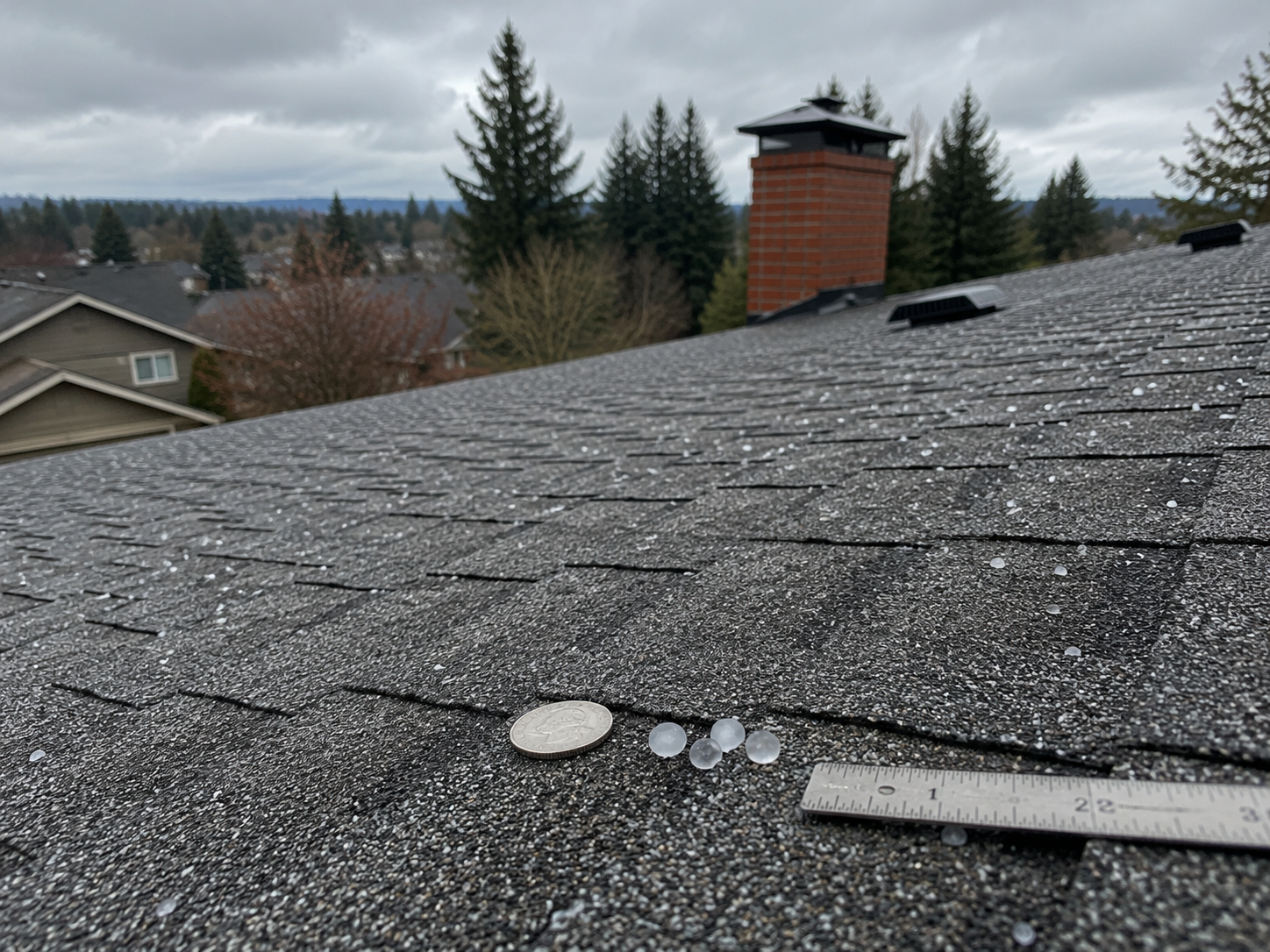
Document these six things, in this order
Hail evidence is perishable. Stones melt, wind clears the debris, and within a day the only proof left is on the roof itself — where you cannot safely go. Do these before anything else.
- The hail itself, with something for scale. A quarter is 0.95 inches, a golf ball is 1.75. Put one next to the stones and photograph it. Size is the first thing an adjuster asks and the hardest thing to prove after the fact.
- Date and time, written down. Your phone timestamps the photo, but note it separately too. The adjuster will cross-reference your date against radar and NWS storm reports, and a date that does not match a real storm sinks the claim.
- Soft metal around the house. Gutters, downspouts, furnace and dryer vents, the AC condenser fins, the mailbox. Aluminum dents where shingles only bruise, so this is your visible, ground-level proof that hail of a damaging size actually fell on your address.
- Anything painted or wooden. Deck boards, fence tops, window sills. Fresh hail marks look bright against weathered wood and are easy to photograph.
- Granules in the gutters and at the downspout outlets. A heavy scatter of the coloured grit from your shingles is a direct sign the roof surface took impacts.
- Interior water stains, if any. Ceilings, around chimneys, in the attic. Photograph with a light source so the stain edge is visible.
Then stop and get the roof looked at. Everything above is circumstantial — it proves hail fell, not that your roof is damaged. Only an inspection does that, and only from on the roof.
Why Spokane hail damage gets missed
The National Weather Service Spokane office notes that hail “often occurs across the Inland Northwest,” with stones ranging from pea-size (about 3/8 of an inch) up to nearly five inches. Our big events are real but rare — NWS recorded 1.5-inch hail near Newport on July 10, 2003, and the May 31, 1997 severe outbreak produced hail of 2 to 3 inches across parts of the state.
Most Spokane hail is nothing like that. It is pea to nickel sized, it lasts ten minutes, and nobody thinks about it again. That creates a specific local problem:
- Small hail still bruises shingles. It does not punch holes, so there is nothing to see from the ground.
- Homeowners do not file, because nothing looked broken. By the time a leak appears the following spring, the claim window has closed and the insurer calls it wear and tear.
- Roofs here are already working hard. Freeze-thaw cycling, summer UV and heavy snow load all age a shingle. A bruised shingle is simply the first one to fail.
If a storm dropped hail on your street, it is worth twenty minutes of somebody’s time to check — even if the roof looks untouched.
What hail damage actually looks like on a shingle
Three things separate a real hail hit from ordinary ageing. An adjuster is looking for all three.
- Bruising. The stone hits hard enough to damage the fibreglass mat underneath without breaking the surface. It feels soft and slightly springy under thumb pressure — like pressing a bruise on fruit. This is the most common form of hail damage and the most commonly missed.
- Mat fracture. The mat beneath the granules has actually cracked. The shingle will fail at that point, but often not for months.
- Granule loss in a random scatter. Small round or teardrop bald spots exposing the black asphalt. The pattern matters: hail lands randomly, while wear-related granule loss follows drainage lines and shows up evenly along the lower courses.
The pattern test is what usually settles a disputed claim. Random impacts across every slope, worse on the side facing the storm, with matching dents on the metal — that reads as hail. Uniform thinning along the eaves reads as a roof that is simply old.
The test square: what the adjuster will do
Adjusters do not assess the whole roof. They mark out a test square — typically a 10 ft by 10 ft area on each slope — and count the hail impacts inside it. That count, extrapolated across the roof, decides repair versus full replacement.
This is the single most useful thing to understand about a hail claim, for two reasons:
- Where the square goes changes the outcome. A square placed on a sheltered slope finds fewer hits than one on the exposed side.
- Bruises have to be found to be counted. They are invisible; they have to be felt. An adjuster working quickly across a lot of properties after a storm can miss them.
This is why it is worth having your roofer on the roof at the same time as the adjuster. When both parties count the same squares, the scope is usually agreed on the spot. When they differ, the contractor can point to the specific bruises they marked — which resolves most disagreements without anybody escalating anything.
Two policy details that decide what you actually get paid
Read these on your own policy before you file. They matter more to the cheque than anything on the roof.
Cosmetic damage exclusions
Some policies now carry a cosmetic damage endorsement that excludes hail marks which do not affect performance — dented vents, dented metal roofing, minor granule loss that does not expose the asphalt. Functional damage (mat fractures, bruising, granule loss that exposes the mat) should still be covered. If your claim is denied as “cosmetic,” the question to ask is whether the adjuster found and tested for mat damage, or only looked at the surface.
Actual cash value vs replacement cost
An actual cash value policy pays the depreciated value of a 15-year-old roof, which on a hail claim can be less than half the cost of replacing it. A replacement cost policy pays the full cost, usually in two instalments — the depreciated amount up front and the remainder once the work is done and invoiced. Same damage, very different outcome. Check which you have before the adjuster arrives, not after the estimate lands.
Deadlines, and how the claim runs
Washington sets clear timelines on the insurer once you file: ten working days to acknowledge your claim and thirty days to complete the investigation, under the Unfair Claims Settlement Practices Regulation. We set those out in full, with the extension rules, in our guide to wind damage roof insurance claims — the same deadlines apply to hail.
Your own deadline to file is the tighter one. Policies require prompt notice and typically allow one year from the date of loss to bring suit, but the practical limit is far shorter. Every month you wait makes it easier to argue the damage came from age rather than a specific storm.
How Avidus helps — and what we can’t do
What we do: inspect the roof at no cost, mark and photograph test squares the way an adjuster does, document bruising and mat damage to the standard they expect, write a line-item estimate, and meet your adjuster at the property to walk them through what we found. Then we do the work, backed by a 10-year workmanship warranty.
What we don’t do: negotiate or settle the claim on your behalf. In Washington that is the role of a licensed public adjuster, not a roofing contractor. Any roofer promising to handle the insurance company for you is describing something they may not be licensed to do. We give your adjuster better information than they would otherwise have — the decision stays with you.
Frequently asked questions
How big does hail have to be to damage a roof?
There is no single threshold. One inch is a common rule of thumb for damaging asphalt shingles, but an older or already-brittle roof can bruise from hail well under that, and wind driving the stones sideways increases the impact force. Age and condition matter as much as size, which is why the roof has to be inspected rather than assumed from the storm report.
How long after a hailstorm can I file?
Your policy will require prompt notice and typically sets one year from the date of loss to bring suit. Treat the practical window as weeks. Hail damage is the easiest kind for an insurer to reattribute to ageing, and every season that passes strengthens that argument.
My neighbour got a new roof. Does that mean I will?
Not necessarily, and it is worth checking rather than assuming either way. Hail falls unevenly, roof ages differ, slope orientation differs, and their policy may pay replacement cost while yours pays actual cash value. It is a good reason to get inspected, not a guarantee of the same result.
Can hail damage be repaired instead of replacing the whole roof?
Sometimes, when impacts are confined to one slope and your shingle can still be matched. Hail rarely cooperates — it usually lands across every slope, which is what pushes a claim toward full replacement. Discontinued shingles also matter: if no reasonable match exists, that is a legitimate argument for replacing rather than patching.
Should I let a door-knocker inspect my roof after a hailstorm?
Be careful. Out-of-state crews follow hail events and some are fine, but many are gone before a warranty is worth anything. Before signing, check for a Washington contractor registration and a local address, and never sign a document that assigns your claim benefits to the contractor without reading exactly what it gives away.
Do you charge for a hail damage inspection?
No. Inspection and the written estimate are free, with no obligation. If we do not think you have a claim worth filing, we will tell you — a denied claim still goes on your record.
Had hail on your street? Get it checked before the evidence goes.
Avidus Roofing & Exteriors is a family-owned, licensed and insured Spokane roofing contractor. We handle storm and insurance restoration, roof repair and full roof replacement across Spokane, Spokane Valley, Liberty Lake, Airway Heights, Cheney and Deer Park. Every replacement is backed by a 10-year workmanship warranty.
Want a ballpark number first? Our free roof estimate calculator takes about 60 seconds.
This article is general information for Spokane homeowners, not legal or insurance advice. Coverage depends on your specific policy. For claim disputes, contact the Washington State Office of the Insurance Commissioner or a licensed professional.