
Wind Damage Roof Insurance Claims in Spokane: A Step-by-Step Guide
Most Spokane homeowners have one year from the date of the storm to file a wind damage roof claim, and Washington law gives your insurer 10 working days to acknowledge it and 30 days to complete the investigation. The single biggest thing you can do to protect your claim is document the damage before anything is repaired or cleaned up.
Wind is the damage we see most often in Spokane — more than hail, more than snow load. This guide walks through exactly what to do after a windstorm, what your insurance company is legally required to do, and where these claims usually go wrong.
Free storm damage inspection
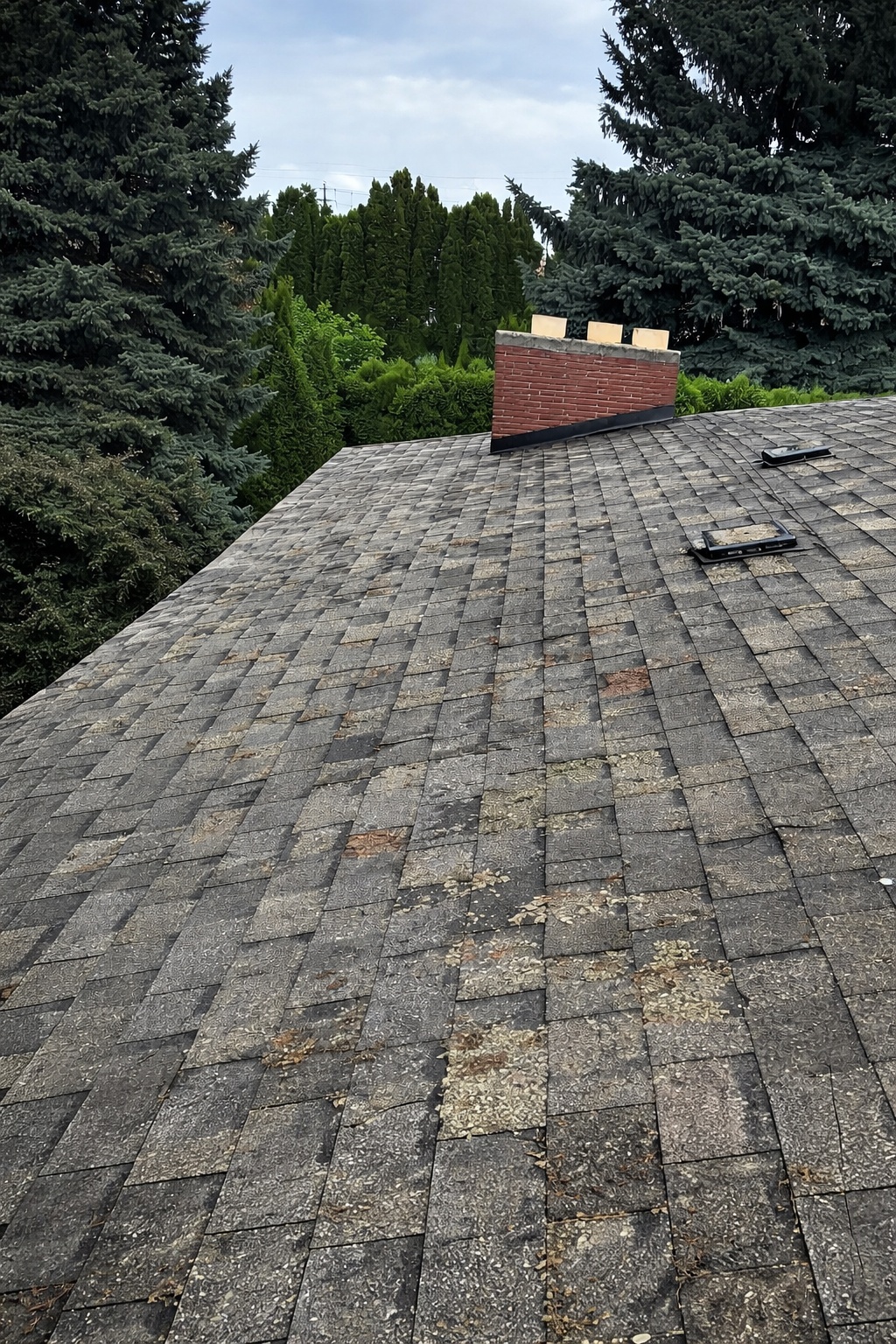
What counts as wind damage to a roof
Insurers treat wind as a covered peril on almost every standard homeowners policy in Washington. The dispute is rarely about whether wind damage is covered — it’s about whether the damage on your roof was caused by wind, and whether it’s bad enough to justify replacement rather than a patch.
Damage an adjuster will typically accept as wind-related:
- Missing shingles — the most obvious sign, and the easiest to document.
- Creased or lifted shingles — wind bends the shingle back and breaks the seal. The shingle often falls back into place and looks fine from the ground, but the seal is gone and it will leak.
- Granule loss in concentrated areas — usually along edges and ridges where wind uplift is strongest.
- Damaged or displaced ridge caps — the first thing to go in a high-wind event.
- Torn or lifted flashing around chimneys, vents and valleys.
- Impact damage from falling limbs — extremely common in Spokane, where mature ponderosa pines sit over a lot of roofs.
The one most homeowners miss is the creased shingle. From the driveway the roof looks untouched. From the roof, an entire slope can have broken seals — and that damage is what causes leaks three months later, long after the claim window has closed.
What Spokane wind actually does to roofs
Spokane doesn’t get hurricanes, but it gets serious wind. Two events set the benchmark:
- November 17, 2015. Gusts over 70 mph brought down roughly 1,900 trees inside Spokane city limits and left about 180,000 homes without power. Avista called it the worst damage in the utility’s 126-year history, and the average customer was out of power for three to five days.
- January 13, 2021. A 71 mph gust at Spokane International Airport tied 2015 for the strongest non-thunderstorm gust on record. The damage was concentrated into a few hours rather than spread across a day.
You don’t need a record-setting storm to lose shingles. Most asphalt shingles are warranted to somewhere between 60 and 130 mph when correctly installed and fully sealed — but that rating assumes ideal conditions. An older roof, a hot-then-cold Spokane winter, or a partially sealed strip from the original install will let go well below the rated speed. We regularly find wind damage after gusts in the 40 to 50 mph range, which Spokane sees several times a year.
The other Spokane-specific factor is the tree canopy. Neighborhoods like the South Hill, Browne’s Addition and Comstock have large mature pines directly over rooflines. In a wind event, the roof damage often isn’t from the wind at all — it’s from what the wind threw at it.
The first 48 hours: what to do after a windstorm
What you do immediately after the storm matters more to your claim than anything that happens later.
- Photograph everything before you touch it. Shingles in the yard, limbs on the roof, debris, interior water stains. Wide shots that show the whole house, then close-ups. Your phone timestamps them automatically — that timestamp is what ties the damage to the storm date.
- Do not throw away shingles that blew off. Put them in the garage. They are physical evidence, and they let an inspector match the product and age.
- Stay off the roof. A wet or wind-damaged roof is genuinely dangerous, and walking it can cause damage an adjuster will later attribute to you. Get it inspected by someone insured to be up there.
- Make reasonable temporary repairs — and keep the receipts. Your policy requires you to prevent further damage. Tarping an open section is expected, and the cost is usually reimbursable. Permanent repairs before the adjuster sees it are not.
- Write down the storm date and conditions. Note the date and rough wind speed. The National Weather Service Spokane office publishes gust records, and an adjuster will check them.
- Get an independent roof inspection before you file. Walking into a claim knowing the full extent of the damage is a completely different conversation than finding out from the adjuster.
- Then file the claim with your photos and the inspection report already in hand.
Our storm damage inspections are free, and we will tell you honestly if we don’t think you have a claim worth filing. A denied claim still goes on your record.
What your insurance company is legally required to do
Washington has some of the clearer claim-handling rules in the country, set out in the Unfair Claims Settlement Practices Regulation (WAC 284-30). Most homeowners have no idea these deadlines exist.
| What has to happen | Deadline |
|---|---|
| Insurer acknowledges receipt of your claim | 10 working days from notification |
| Insurer completes its investigation | 30 days from notification, unless it reasonably cannot |
| If more time is needed, insurer must tell you why | Within 15 working days of receiving your proof of loss |
| Further written explanation if still unresolved | 45 days from the first notification |
| Continuing updates after that | Every 30 days, in writing |
If your insurer goes quiet past these windows, you can reference the WAC section directly in writing. You can also file a complaint with the Washington State Office of the Insurance Commissioner, which is free and often gets a stalled claim moving.
Separately, check your own policy for the deadline to file. Most Washington homeowners policies require notice promptly and set a one-year limit from the date of loss to bring suit. Don’t sit on a claim through a winter.
Where wind claims usually go wrong
- Waiting too long. The most common reason a legitimate claim gets denied. Once a season passes, the insurer can argue the damage is wear and tear.
- “Wear and tear,” not wind. Older roofs draw this denial constantly. Good documentation of creasing and broken seals — which are mechanical, not age-related — is what counters it.
- Repair approved instead of replacement. An insurer may approve replacing 15 shingles on a roof where the product has been discontinued and no match exists. That is a legitimate thing to push back on, with documentation.
- Cleaning up first. Homeowners tidy the yard, throw out the shingles, and lose their evidence.
- Signing with a storm chaser. After every big Spokane wind event, out-of-state crews show up door to door. Some are fine. Many disappear before the warranty matters. Check for a Washington contractor registration and a local address before you sign anything.
How Avidus helps — and what we can’t do
It is worth being precise about this, because a lot of roofing companies aren’t.
What we do: inspect your roof at no cost, photograph and document the damage to the standard adjusters expect, write a detailed line-item repair or replacement estimate, meet your adjuster at the property, and walk them through what we found. Then we do the work and stand behind it with a 10-year workmanship warranty.
What we don’t do: negotiate or settle the claim on your behalf. In Washington, representing a policyholder in a claim negotiation is the role of a licensed public adjuster, not a roofing contractor. Any roofer who tells you they will handle the insurance company for you is describing something they may not be licensed to do. We give your adjuster better information than they would otherwise have — the decision and the negotiation stay with you.
In practice, thorough documentation is what moves most claims. Adjusters are covering a lot of properties after a storm, and a complete, photo-backed, line-item estimate handed to them on site does more than any amount of arguing.
Frequently asked questions
Will filing a wind damage claim raise my premium?
A single weather-related claim is treated differently from an at-fault claim, and wind is classified as an act of nature. Rates can still change at renewal, and repeated claims do have an effect. Ask your agent directly before filing, and weigh it against the cost of the repair. If the damage is close to your deductible, paying out of pocket is often the better call.
How long do I have to file a wind damage claim in Washington?
Your policy will require prompt notice and typically sets one year from the date of loss as the limit to bring suit. The practical deadline is much shorter — the longer you wait, the easier it is for the insurer to argue the damage came from age rather than a specific storm. File within weeks, not months.
My roof looks fine from the ground. Should I still get it inspected?
Yes, if your neighborhood took a real wind event. Creased shingles — where the seal has broken but the shingle fell back into place — are invisible from the ground and are the most common form of wind damage we find. They don’t leak immediately; they leak months later, after the claim window has passed.
Does insurance pay for a full roof replacement or just repairs?
It depends on how widespread the damage is and whether your shingle can still be matched. Insurers generally approve repair where a reasonable match exists and replacement where it doesn’t, or where damage spans multiple slopes. Whether your policy pays actual cash value or replacement cost also changes the number significantly — check which you have.
What if my claim is denied?
Request the denial in writing with the specific policy language relied on. You can ask for re-inspection, provide an independent inspection report, or escalate. If you believe the claim was mishandled, the Washington State Office of the Insurance Commissioner takes consumer complaints at no cost. For disputes over the amount rather than coverage, a licensed public adjuster or an attorney is the appropriate next step.
Do you charge for a storm damage inspection?
No. Inspection and the written estimate are free, with no obligation. If we don’t think you have a claim worth filing, we will tell you.
Had a windstorm? Get it documented before it’s too late.
Avidus Roofing & Exteriors is a family-owned, licensed and insured Spokane roofing contractor. We handle storm and insurance restoration, roof repair and full roof replacement across Spokane, Spokane Valley, Liberty Lake, Airway Heights, Cheney and Deer Park. Every replacement is backed by a 10-year workmanship warranty.
Want a ballpark number before you call? Try our free roof estimate calculator — it takes about 60 seconds.
This article is general information for Spokane homeowners, not legal or insurance advice. Coverage depends on your specific policy. For claim disputes, contact the Washington State Office of the Insurance Commissioner or a licensed professional.